Artificial intelligence is no longer a futuristic idea for contact centres; it is a practical toolkit that is already reshaping how organisations support their customers. From smarter self-service to real-time agent coaching, AI is turning the contact centre into a strategic engine for customer experience and business growth. Today, an 인공지능 컨택 센터 can transform operations, while leveraging AI call center performance advantages helps organisations deliver faster, smarter, and more consistent service.
This guide explains what an artificial intelligence contact centre actually is, how it works, and the real benefits it can bring to your organisation. You will also find practical steps for getting started, so you can move from experimentation to meaningful results.
Expanding your AI capabilities in a contact centre often starts with understanding high-performance computing for customer insights, which allows agents to access complex data faster than ever. Companies are increasingly exploring supercomputer resources for small businesses to handle large-scale analytics and predictive models efficiently. At the same time, integrating innovative marketing strategies for customer retention ensures that every AI interaction not only resolves issues but also builds lasting relationships.
For teams looking to scale, learning from advanced AI computing projects can provide real-world examples of efficiency gains, cost reduction, and faster response times. When applied correctly, these approaches help create a contact centre that is not only intelligent but also proactive in meeting customer needs. Many organisations also turn to financial analytics and strategic planning resources to align operational improvements with business goals, ensuring AI investments drive measurable ROI.
Finally, keeping up with emerging digital marketing trends and tools helps contact centres leverage AI for more personalized campaigns, predictive outreach, and enhanced customer engagement. The combination of smart technology and informed strategy transforms the artificial intelligence contact centre into a hub for innovation, efficiency, and superior customer experiences.
Top 10 Artificial Intelligence Contact Center Solutions in 2025
Artificial intelligence contact centers are transforming the way businesses engage with customers. By combining smart automation, real-time insights, and predictive analytics, these platforms help organizations improve efficiency, reduce costs, and deliver exceptional customer experiences. Here’s a list of the top 10 AI-powered contact center solutions today.
1. Bright Pattern
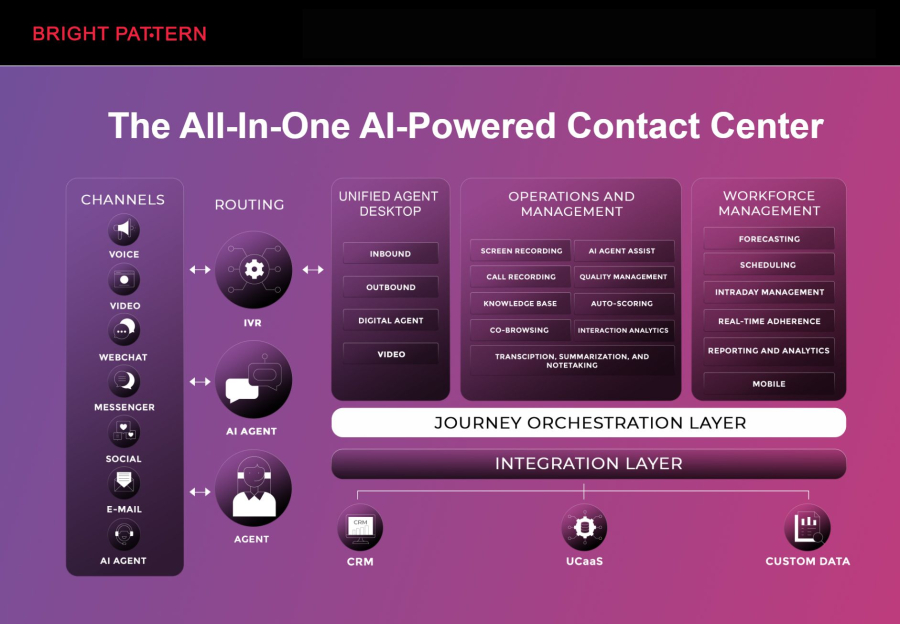
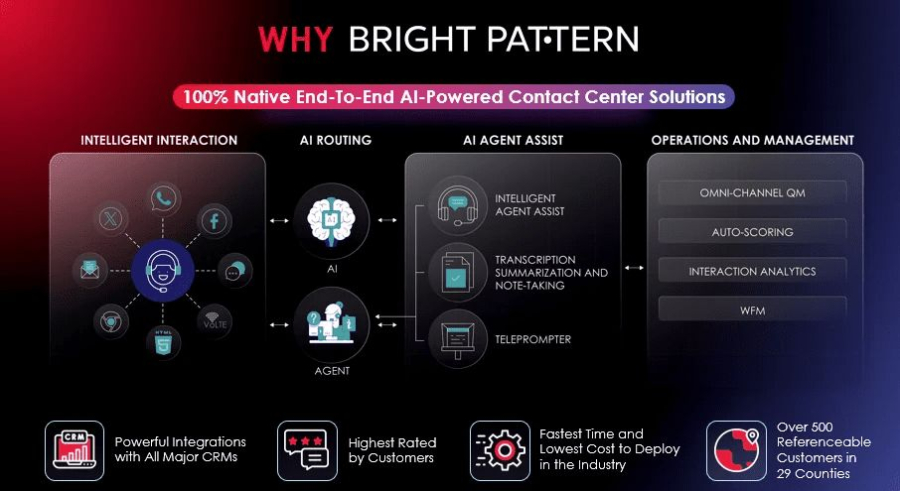
Bright Pattern is a leading artificial intelligence contact center platform that offers a cloud-native solution for businesses of all sizes. It is designed to streamline customer interactions across multiple channels while providing intelligent automation and analytics.
Key features include:
- Omnichannel routing to seamlessly connect customers via voice, chat, email, and social media
- AI-driven agent assistance and real-time coaching
- Intelligent automation for routine tasks, freeing agents to focus on complex issues
- Advanced analytics and reporting to optimize contact center performance
- Easy integration with CRM systems and other business tools
Bright Pattern’s platform is ideal for organizations looking to implement an AI-powered contact center that scales with their growth while maintaining high-quality customer service.
2. Genesys
Genesys offers an AI contact center solution that emphasizes customer engagement and workforce optimization. Its AI capabilities include predictive routing and automated self-service.
3. NICE inContact
NICE inContact delivers cloud contact center software with built-in AI tools for agent assistance, customer insights, and performance analytics.
4. Five9
Five9 provides an intelligent contact center platform that uses AI to enhance agent efficiency and customer satisfaction, including virtual agents and omnichannel routing.
5. Talkdesk
Talkdesk’s AI-driven contact center solution focuses on automating repetitive tasks, improving agent workflows, and analyzing customer interactions for better decision-making.
6. 8x8
8x8 integrates AI-powered analytics, chatbots, and real-time guidance to optimize contact center operations and improve customer engagement.
7. RingCentral
RingCentral’s contact center solution leverages artificial intelligence for workforce management, analytics, and automated customer interactions across multiple channels.
8. Zendesk
Zendesk AI contact center software combines customer support automation with AI insights to help agents resolve issues faster and more efficiently.
9. Amazon Connect
Amazon Connect provides a scalable cloud contact center platform with AI tools for natural language understanding, speech recognition, and automated workflows.
10. Genesys DX
Genesys DX (formerly Bold360) focuses on delivering AI-powered chatbots and virtual assistants to enhance customer experiences and support agents.
What Is an Artificial Intelligence Contact Centre?
Anartificial intelligence contact centreis a customer service operation that uses AI technologies to automate routine tasks, support human agents and improve the overall customer experience. Instead of relying solely on manual processes and static scripts, an AI-enabled contact centre uses data and machine learning to make smarter, faster decisions.
Key elements often include:
- AI-powered self-servicesuch as virtual agents and chatbots that handle common questions without human intervention.
- Intelligent routingthat directs each contact to the best resource based on intent, skills and context.
- Real-time guidancefor agents, including suggested responses and next best actions.
- Analytics and insightsthat automatically surface trends, quality issues and opportunities for improvement.
Rather than replacing people, a successful AI contact centre amplifies human capability. It gives customers faster, more convenient support while freeing agents to focus on higher-value, more rewarding work.
Core AI Technologies Powering Modern Contact Centres
Several technologies come together to create an effective AI-driven environment. Understanding the basics makes it easier to see where AI can add value in your own contact centre.
1. Natural Language Processing (NLP)
Natural Language Processingenables machines to understand and respond to human language. In a contact centre, NLP powers:
- Chatbotsthat interpret written queries and provide helpful answers.
- Voicebotsthat understand spoken requests in IVR or voice channels.
- Intent detectionthat identifies why a customer is getting in touch, even when they do not use standard phrases.
Effective NLP allows your systems to move beyond rigid menus and keyword matching towards more natural, human-like conversations.
2. Machine Learning (ML)
Machine Learningis about systems that improve with data over time. In an AI contact centre, ML models can:
- Predict which queries are likely to escalate and need senior attention.
- Recommend the best response or next action based on similar past cases.
- Forecast contact volumes to support more accurate workforce planning.
The more data the system processes, the better it becomes at making accurate, helpful predictions.
3. Speech Analytics and Voice Recognition
Speech analyticsconverts recorded calls into text and then analyses them at scale. This helps you to:
- Identify common reasons for contact.
- Spot compliance risks or potentially vulnerable customers.
- Measure sentiment and emotional tone throughout conversations.
Combined with voice recognition, AI can even support real-time transcription and coaching while a call is in progress.
4. Robotic Process Automation (RPA)
While not strictly AI,Robotic Process Automationoften works alongside AI in a modern contact centre. RPA tools automate repetitive, rules-based tasks such as:
- Copying data between systems.
- Triggering follow-up emails or confirmations.
- Updating records after a call or chat.
When AI identifies what needs to happen next, RPA can execute the steps in the background, saving time and reducing errors.
Key Benefits of an AI-Enabled Contact Centre
AI is most powerful when it is linked to clear business outcomes. Below are some of the most compelling benefits organisations see when they modernise their contact centres with AI.
|
Benefit area |
How AI helps |
Positive outcome |
|
Customer experience |
Always-on self-service, personalisation and faster responses. |
Higher satisfaction, stronger loyalty and reduced effort. |
|
Operational efficiency |
Automation of routine tasks and smarter routing. |
Lower handling times and reduced cost per contact. |
|
Agent performance |
Real-time coaching, knowledge suggestions and simpler workflows. |
Improved quality, confidence and engagement. |
|
Business insight |
Analytics across every interaction and channel. |
Faster decision-making and better strategic planning. |
1. Faster, More Convenient Customer Service
Today’s customers expect answers in minutes, not days. AI helps you meet those expectations consistently by:
- Providing24/7 self-servicethrough intelligent chatbots and virtual agents.
- Shortening queues by resolving simple queries automatically.
- Automatically identifying a customer’s intent and routing them to the right person first time.
Instead of waiting on hold or navigating complex menus, customers get quick, accurate help on their preferred channel.
2. Personalised, Context-Aware Interactions
AI can draw on data from previous interactions, purchase history and customer profiles to personalise each conversation. This can include:
- Greeting customers by name and recognising repeat contacts.
- Tailoring offers and recommendations to their specific situation.
- Adjusting tone or escalation paths based on sentiment and urgency.
When every interaction feels tailored and relevant, customers feel valued and are more likely to stay loyal over time.
3. Empowered, More Confident Agents
Far from replacing agents, AI can make their jobs easier and more rewarding. For example:
- Real-time guidancesurfaces suggested responses, compliance prompts and knowledge articles as the conversation unfolds.
- Automated after-call workreduces time spent on notes and system updates.
- Sentiment indicatorshelp agents judge when to slow down, show empathy or escalate.
When admin work and searching for information are reduced, agents can focus on what humans do best: building trust, solving complex problems and creating memorable experiences.
4. Smarter Workforce Management and Cost Control
AI-based forecasting can predict contact volumes more accurately by learning from historical patterns and external factors. This supports:
- Better scheduling, with the right number of agents available at the right times.
- Reduced overtime and staffing costs.
- Smoother seasonal or promotional peaks.
Combined with automation of routine contacts, this helps you control costs without compromising on service quality.
5. Continuous Improvement Driven by Data
Every interaction in an AI contact centre becomes a source of insight. Speech and text analytics can automatically highlight:
- Emerging issues or product problems.
- Common reasons for contact that could be resolved through better self-service.
- Coaching opportunities for individual agents or teams.
Instead of relying on small samples of calls or manual reporting, leaders gain an always-on, data-driven view of performance and customer needs.
Popular Use Cases for AI in the Contact Centre
AI can be applied across the customer journey, from first contact to follow-up. Here are some of the most effective use cases organisations implement first.
AI-Powered Virtual Agents and Chatbots
Virtual agents handle common tasks such as balance enquiries, order tracking, password resets and appointment bookings. When designed carefully, they:
- Resolve a high proportion of simple, repetitive interactions without human input.
- Hand off seamlessly to a live agent when queries become complex.
- Maintain context so customers do not have to repeat themselves.
This frees your human team to concentrate on high-value, emotionally sensitive or complex cases.
Intelligent IVR and Voicebots
Traditional IVR menus can be frustrating. AI voicebots improve the experience by allowing callers to speak naturally, for example:
- “I want to change my delivery address.”
- “I need to query a transaction.”
The system interprets the intent using NLP and either resolves the request directly or routes the caller to the most suitable agent, along with a summary of the issue.
Real-Time Agent Assist
Agent assist tools run in the background during calls or chats, listening and analysing the conversation. They can:
- Suggest relevant answers from a knowledge base.
- Flag compliance statements that must be read.
- Highlight opportunities to cross-sell or upsell where appropriate.
Instead of switching between multiple screens or searching through documents, agents receive timely prompts that help them resolve issues quickly and accurately.
Automated Quality Monitoring
Manually reviewing a handful of calls each month gives a limited view of performance. AI-driven quality monitoring can analyse every interaction across voice and digital channels. This enables you to:
- Apply consistent quality and compliance checks at scale.
- Identify best-practice behaviours and replicate them across the team.
- Spot training needs early, before issues become widespread.
With automated scoring and alerts, your quality team can focus on targeted coaching and continuous improvement.
Proactive Service and Retention
By analysing patterns in behaviour and sentiment, AI can help you anticipate customer needs. This might include:
- Flagging accounts that show signs of potential churn.
- Triggering proactive outreach when a known issue is likely to affect certain customers.
- Recommending personalised retention offers during at-risk conversations.
Moving from reactive to proactive service strengthens relationships and protects revenue.
Designing an AI Contact Centre Strategy
Introducing AI is not just a technology decision; it is a strategic shift. A clear plan will help you deliver meaningful benefits rather than isolated pilots that never scale.
1. Start With Business Outcomes
Before choosing tools, clarify what you want to achieve. Common objectives include:
- Reducing average handling time or queue lengths.
- Improving first-contact resolution.
- Boosting customer satisfaction or net promoter scores.
- Enhancing compliance or risk management.
Defining success up front guides your priorities and helps you measure impact later.
2. Map Customer Journeys and Pain Points
Look at your key journeys across voice, email, chat, social and messaging. Where are customers struggling or waiting too long? Where are agents spending time on repetitive tasks?
These pressure points are often the best candidates for AI, because even small improvements can deliver visible benefits to both customers and colleagues.
3. Prioritise High-Value, Low-Risk Use Cases
Begin with use cases that are:
- Frequent and predictablesuch as FAQs, tracking or standard updates.
- Clearly definedwith simple, rules-based resolutions.
- Non-sensitivein terms of data and emotional impact.
This allows you to demonstrate quick wins and build confidence, while you gather data and feedback to refine your approach.
4. Involve Agents and Team Leaders Early
Agents are closest to your customers and processes, so their input is invaluable. Involving them early helps you to:
- Identify practical opportunities where AI can remove friction.
- Design workflows that genuinely support day-to-day work.
- Build trust by showing that AI is there to help, not replace.
When agents feel consulted and supported, adoption is smoother and results tend to be stronger.
5. Plan Data, Governance and Responsible Use
AI depends on data. To get the best from your tools, you need clear thinking about:
- Data qualityso that models are trained on accurate, relevant information.
- Privacy and securityincluding how customer data is stored, accessed and anonymised where appropriate.
- Ethical guidelinesto ensure transparency, fairness and accountability in automated decisions.
A responsible foundation not only protects your organisation, it also builds customer trust in your use of AI.
Practical Steps to Implement AI in Your Contact Centre
Once your strategy is clear, you can move into practical delivery. A structured approach helps you move quickly while maintaining control.
Step 1: Assess Your Current Technology Landscape
Review your existing contact centre platform, CRM, knowledge bases and analytics tools. Key questions include:
- Which systems already support AI capabilities you may not be using fully?
- Where are there gaps that new tools could fill?
- How easily can different systems integrate and share data?
This assessment helps you avoid duplication and ensures new AI tools sit comfortably within your broader technology ecosystem.
Step 2: Build a Cross-Functional Team
Successful AI projects bring together expertise from across the organisation, including:
- Contact centre leaders and team managers.
- Front-line agents and quality specialists.
- IT, data and security professionals.
- Customer experience or journey design experts.
This mix of perspectives helps you balance innovation with practicality, risk management and customer centricity.
Step 3: Develop and Test Prototypes
Rather than attempting a large, complex rollout on day one, start with focused pilots. For example:
- An AI chatbot for a single category of FAQs.
- Real-time agent assist in one specialist team.
- Automated quality monitoring on one channel.
Run controlled tests, gather feedback from customers and agents, and refine your models and workflows before scaling up.
Step 4: Train and Support Your People
Adoption depends on how comfortable people feel with the new tools. Effective enablement includes:
- Clear communication about the benefits and goals of AI.
- Hands-on training sessions with real examples and scenarios.
- Ongoing support channels for questions, ideas and issues.
Position AI as a co-worker that takes away drudgery and amplifies individual strengths, rather than as a replacement for human expertise.
Step 5: Measure, Learn and Iterate
Once live, monitor both quantitative and qualitative indicators, such as:
- Customer satisfaction and effort scores.
- Resolution rates and handling times.
- Agent feedback on usability and impact.
Use these insights to refine conversation flows, improve knowledge content and adjust routing logic. AI systems can improve quickly with focused iterations, so build continuous learning into your operating model.
Supporting a Human-Centred, AI-Enhanced Future
The most successful artificial intelligence contact centres have one thing in common: they keep people at the heart of their design. AI is used to remove friction, automate low-value work and unlock insights, while human agents provide empathy, judgement and creativity.
By taking a strategic, step-by-step approach, organisations can harness AI to:
- Delight customers with fast, personalised support.
- Give agents the tools and confidence to perform at their best.
- Run operations more efficiently, without sacrificing quality.
- Turn everyday interactions into powerful sources of business insight.
As AI capabilities continue to evolve, contact centres have an exciting opportunity to move from cost centres to value creators. With clear goals, responsible governance and a focus on human experience, your organisation can build a modern, AI-enhanced contact centre that is ready for the future of customer service.
